

Stone Facade Maintenance Cost | Exterior Cladding Analysis
Oct 21, 2026
Leave a message
Executive Summary: 50-Year Lifecycle Cost Analysis for Exterior Stone Facades
Natural granite and limestone exterior cladding systems exhibit a significantly lower 50-year lifecycle cost than porcelain tiles and glass curtain walls despite higher initial material procurement costs. While porcelain facade panels experience structural degradation, thermal fatigue, and adhesive failure within 15 to 20 years, structurally anchored natural granite maintains its flexural strength (≥ 12.0 MPa under ASTM C880) and abrasion resistance across a half-century without requiring panel replacement. Institutional building owners and general contractors mitigating long-term structural maintenance expenses achieve a favorable return on investment by prioritizing high-density, low-water-absorption natural stone systems equipped with mechanical anchor kerf cuts.
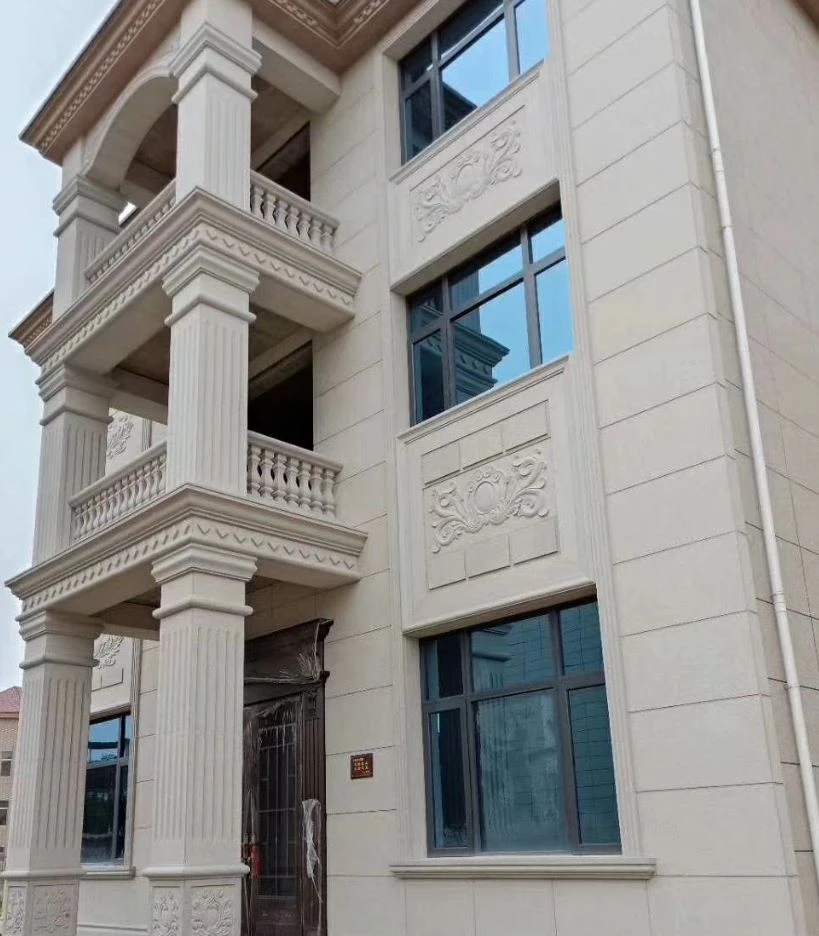
Evaluating exterior building envelopes requires calculating total cost of ownership (TCO) across material acquisition, staging, sub-structure engineering, and ongoing maintenance. While thin porcelain panels present an attractive initial square-meter price point, their lifecycle amortization curves diverge sharply from dimensionally stable natural granite. Porcelain units rely heavily on continuous polymer-modified adhesive beds and are vulnerable to freeze-thaw spalling when moisture penetrates micro-fissures behind the glaze layer.
Natural granite panels, specified at standard thicknesses of 30mm or 25mm, distribute wind loads effectively through stainless steel pin anchors and undercut anchors. The following engineering comparison outlines the core physical properties governing long-term durability in exterior dry-hang applications.
| Performance Metric | Natural Granite (Dense Igneous) | Exterior Porcelain Tile Panels | Testing Standard |
| Bulk Density | $2,600 - 2,800\text{ kg/m}^3$ | $2,300 - 2,400\text{ kg/m}^3$ | ASTM C97 |
| Water Absorption Rate | $< 0.4\%$ | $< 0.1\%$ | ASTM C97 |
| Flexural Strength | $\ge 12.0\text{ MPa}$ | $\ge 35.0\text{ MPa}$ | ASTM C880 / ISO 10545-4 |
| Compressive Strength | $\ge 150\text{ MPa}$ | $\ge 120\text{ MPa}$ | ASTM C170 |
| Thermal Expansion Coefficient | $7.0 \times 10^{-6} /^\circ\text{C}$ | $6.5 \times 10^{-6} /^\circ\text{C}$ | ASTM C37 |
In high-rise commercial structures subject to severe wind load pressures and seismic shifts, natural stone absorbs dynamic loads through independent mechanical fixing brackets. Porcelain facade panels, constrained by brittle fracture limits under point loads, often require complex continuous aluminum carrier grids, offsetting initial material savings.
2. Maintenance Protocols, Weathering Resistance, and Surface Restoration
Building envelopes face continuous degradation from atmospheric pollution, acid rain, ultraviolet radiation, and cyclical thermal shock. Exterior cladding maintenance budgets typically dictate long-term operational expenditures for commercial asset managers and real estate holding firms.
Porcelain tile systems feature factory-baked glazes that resist chemical staining, but surface fractures, chips caused by impact, or edge spalling are fundamentally unrepairable in situ. Damaged porcelain panels require complete deconstruction of surrounding facade anchors, leading to high labor overhead and aesthetic color-lot mismatches.
Conversely, natural granite provides a monolithic mineral composition that allows comprehensive on-site surface restoration. Even after decades of exposure to industrial fallout, exterior granite can be diamond-honed, power-washed, or re-polished to restore original architectural sheen without dismantling the panel from the support frame.
Ultraviolet Stability: Natural granite contains zero synthetic resins in its raw state, eliminating UV-induced yellowing, polymer degradation, or color fading common in resin-bonded composite panels.
Freeze-Thaw Durability: With a controlled water absorption rate below 0.4 percent under ASTM C97 specifications, premium granite resists internal hydraulic pressure during sub-zero temperature drops.
Sealing and Impregnation: Smarter Stone applies penetrating hydrophobic silane-siloxane sealers during factory processing, lowering surface porosity and preventing airborne particulate penetration for 10 to 15 years before reapplication.