

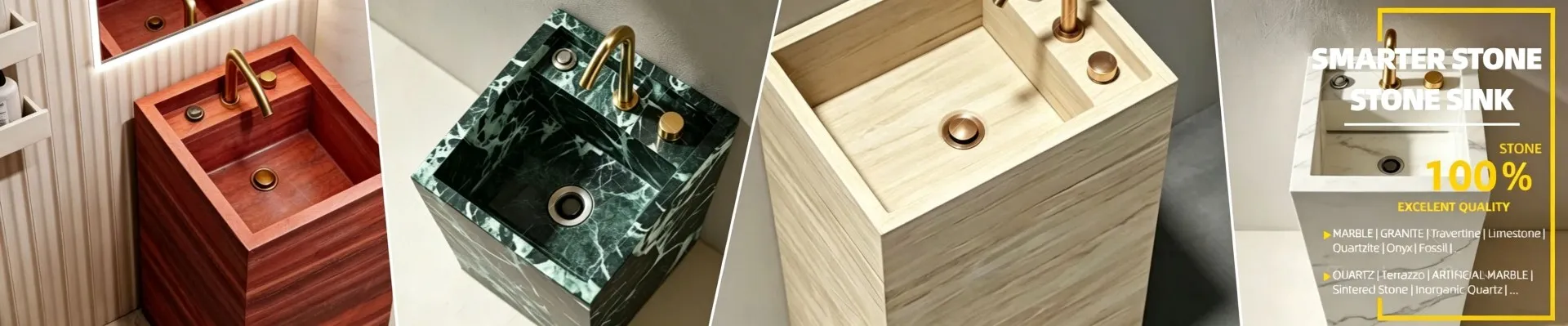
Stone Vanity Tops Wholesale & Undermount Sinks | Smarter Stone
Oct 21, 2026
Leave a message
Pre-assembling undermount ceramic sinks to cut-to-size granite vanity tops at the fabrication plant reduces jobsite labor installation costs by up to 40% for commercial washroom projects. Utilizing high-density granites with a water absorption rate under 0.4% and a Mohs hardness of 6 to 7 ensures zero moisture penetration and structural stability under high-traffic conditions. Smarter Stone delivers fully integrated, epoxy-bonded sink-and-top assemblies featuring CNC-milled edge profiles and reinforced seaworthy packaging compliant with ASTM C97 and EN 14617 standards.
Technical Specifications: Natural Granite vs. Ceramic Sink Bonding Integrity
Selecting the appropriate natural stone substrate for commercial washroom vanity tops requires rigorous evaluation of flexural strength, bulk density, and resistance to chemical abrasion. Commercial restrooms in high-occupancy environments (such as shopping malls, airports, and educational facilities) subject countertop assemblies to continuous dynamic load stresses, moisture exposure, and aggressive cleaning agents.
Granite slabs specified for commercial vanity applications must meet minimum physical performance thresholds. Below is the structural performance comparison between standard commercial grade natural granite and vitreous china undermount ceramic sinks:
| Physical / Mechanical Property | Natural Granite Substrates | Vitreous China Ceramic Sinks | Testing Standard |
| Bulk Density (g/cm³) | 2.60 - 2.85 | 2.15 - 2.30 | ASTM C97 / EN 1936 |
| Water Absorption Rate (%) | ≤ 0.35% | ≤ 0.50% | ASTM C97 / EN 14617-2 |
| Flexural Strength (MPa) | 12.0 - 22.0 | 35.0 - 50.0 | ASTM C880 / EN 12372 |
| Compressive Strength (MPa) | 150.0 - 250.0 | 300.0 - 400.0 | ASTM C170 / EN 1926 |
| Mohs Hardness Rating | 6.0 - 7.0 | 7.0 | EN 101 |
| Chemical Resistance | High (Acid/Alkali Resistant) | High (Acid/Alkali Proof) | ASTM C650 / EN 14617-10 |
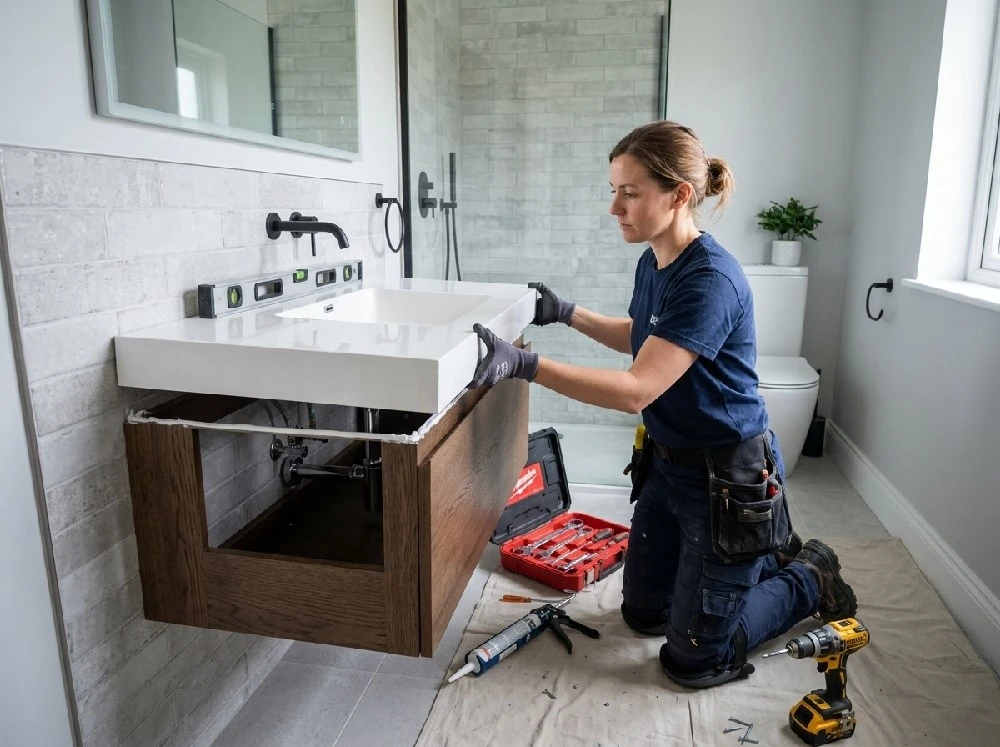
To prevent sink detachment or joint failure over time, Smarter Stone employs a dual-component structural epoxy resin filling system combined with stainless steel undermount sink clips anchored directly into pre-drilled brass threaded inserts on the underside of the granite slab.
[Image Suggestion] Location Insert immediately after the paragraph above, under the heading "Technical Specifications: Natural Granite vs. Ceramic Sink Bonding Integrity".
Industrial Sink Cutout Fabrication and Edge Profile Engineering
Precision processing of sink cutouts determines both the aesthetic alignment and the structural durability of commercial washroom tops. Manual cutting often introduces micro-fractures along the cutout perimeter, increasing the risk of stress cracks during transit and installation.
Smarter Stone utilizes 5-axis CNC bridge cutters and automated waterjet systems to execute sink cutouts with an exact tolerance of ±0.5mm. This guarantees precise alignment between the ceramic basin rim and the stone cutout line, eliminating water pooling hazards.
Edge Profile Specifications for Undermount Cutouts
Eased and Polished Edge: A standard 3mm chamfer top and bottom, fully polished to a gloss reading ≥90 units. Ideal for high-turnout commercial applications due to high impact resistance.
Full Bullnose Edge: A complete 180-degree radius profile applied to the inner perimeter of the sink opening, distributing physical impacts evenly and reducing chip risks.
Mitred Apron Edge: Fabricated by joining a 45-degree bevelled front skirt to the main slab, creating the visual appearance of a 50mm to 100mm thick solid stone block while keeping overall weight manageable.
Water Retaining Edge (Anti-Inundation Spill Groove): A CNC-milled continuous recessed channel (2mm depth, 5mm width) carved along the front and side perimeter of the vanity top to catch surface runoff and prevent liquid from dripping onto washroom floors.
[CTA Block] Hook: Optimize your commercial project margins with pre-assembled, factory-tested granite vanity sets. Button Text: Request Factory Direct Pricing & SGS Test Reports Link Destination: https://www.smarterstone.com/wash-basin/ceramic-sink/
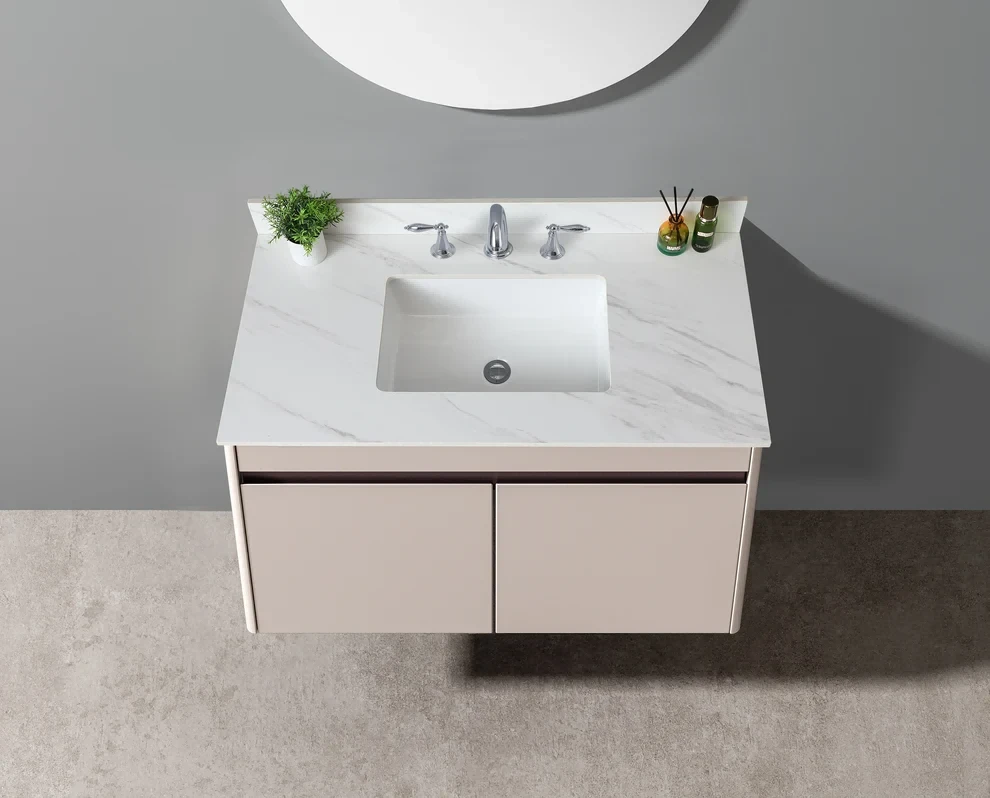
Color Variation Control and Dry-Lay Pre-Assembly Workflow
Natural granite exhibits inherent mineral veining, shade variations, and crystal distribution differences across quarry blocks. For large-scale procurement involving hundreds of uniform washroom units, strict shade sorting is mandatory.
Smarter Stone enforces a standardized Color Variation Control Protocol across all commercial orders:
Block Selection and Quarry Sourcing: Slabs are cut from homogenous quarry blocks within the same geological bench to maintain uniform grain density and background color tones.
Digital Dry-Lay Service: Prior to final edge polishing and sink cutout processing, all cut-to-size slabs are laid out in sequence in our inspection facility. High-resolution overhead cameras capture color density and veining patterns, creating a digital dry-lay layout map for client approval.
Gloss and Surface Uniformity Verification: Automated polishing lines apply liquid epoxy resin treatments under controlled heat to fill micro-fissures and natural pits. Final surface polishing achieves a uniform mirror-like gloss reading of ≥90 units.
[Image Suggestion] Location Insert immediately after the paragraph above, under the section "Color Variation Control and Dry-Lay Pre-Assembly Workflow". Image Description: High-angle wide shot of a factory dry-lay service floor with numbered commercial granite vanity tops arranged in sequence for shade matching and quality control inspection. ALT Tag: Factory dry-lay inspection and shade matching for wholesale granite vanity tops.
Anti-Vibration Packaging and Container Logistics Standards
Breakage during ocean transport represents one of the highest cost risks for wholesale importers and building materials distributors. Standard packaging frequently fails under severe container torque, dynamic road vibrations, and rough fork-lift handling.
To achieve a verified breakage rate control of less than 0.5% across international shipments, Smarter Stone employs reinforced packing engineering:
Seaworthy Fumigated Wooden Crates: All packaging timber undergoes heat treatment and chemical treatment strictly compliant with ISPM 15 standards, issued with official Fumigation Certificates. Crates are constructed using 20mm thick solid hardwood panels reinforced with diagonal bracing.
A-Frame and Bundle Packing Options: Slabs and finished vanity tops are secured in vertical A-frame racks or heavy-duty crate bundles. Individual stone pieces are separated by 2mm polyethylene foam sheets to prevent surface abrasion.
Factory Pre-Assembly Packaging: For vanity tops shipped with pre-installed undermount sinks, custom high-density EPE foam cradles surround the ceramic basin underside. This absorbs transit shocks and prevents shear stress on the epoxy bond line.
Container Loading and Lashing Protocols: Packed wooden crates are strapped inside 20ft GP heavy-duty containers using high-tensile steel banding and plastic corner protectors. Heavy wooden chocks are nailed directly to the container floor to eliminate lateral movement during high-seas shipping.
[CTA Block] Hook: Eliminate transit breakage and reduce site labor with our seaworthy packaged vanity top assemblies. Button Text: Contact Our Engineering Team for Custom Quotations Link Destination: https://www.smarterstone.com/countertop/bathroom-countertop/
Frequently Asked Questions (FAQ)
How does factory pre-assembling undermount sinks reduce overall project costs for commercial contractors?
Factory pre-assembly eliminates manual jobsite measuring, cutting, and epoxy curing time. Installing completed vanity assemblies directly onto cabinetry cuts field labor duration by up to 40%, eliminates jobsite dust pollution, and reduces overall breakage risks during manual fitting.
What quality control standards prevent ceramic undermount sinks from detaching from granite vanity tops?
Smarter Stone uses structural two-part epoxy adhesives paired with mechanical stainless steel anchor clips pre-drilled into the stone backing. This dual-fastening method complies with ASTM mechanical loading requirements and prevents bond separation caused by moisture exposure or dynamic load impact.
How is color variation managed across multi-container orders of natural granite vanity tops?
We source raw granite from identical quarry blocks, conduct automated shade grouping, and perform a mandatory digital dry-lay layout prior to final cutting. Clients receive a comprehensive dry-lay map for approval, ensuring shade consistency within tight project tolerances.